Using autobiographical stories to heal childhood trauma

Blog Post 3 – 17th November 2022

~~~

Childhood trauma causes developmental deficits, which can be made up.

Autobiography explores how this was done…

By Dr Jim Byrne, Doctor of Counselling, and survivor of childhood developmental trauma.

~~~

The most important relationship in every human life is that between the mother and child…

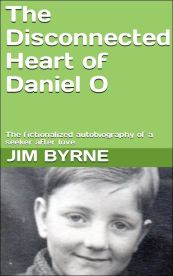
Kindle coverThis book is about one man’s journey away from his homeland and his emotionally barren family and priest-dominated culture, to a place where he might find love, acceptance and personal liberation.
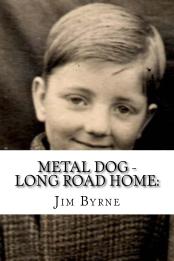
The author describes the traumatic events of his childhood, and the bleakness of life in Ireland at a time when dogmatic, all-powerful priests dominated the culture; and in a context where he and his family were country immigrants into an excluding city culture.

Much of his early childhood was repressed out of his conscious awareness, but his life did not work, in school, or as a teenager, because of the unconscious forces that made it difficult for him to relate to others, especially to girls.

In order to try to reconstruct his childhood, he uses a number of ingenious strategies, chief among them being:

– The creation of an alter ego (Daniel) who he follows through a kind of fictional life (based on scanty scraps of memories and family stories), to see how he responds to typical life events;

……For more, please go to this information page…

– The creation of certain archetypes, such as the little white goat; the little blue bear; a team of alien psychologists from another galaxy, who observe Daniel’s life, and discuss the psychological significance of certain developments.

……For more, please go to this information page…

– The development of a self-analysis, using various psycho-therapeutic ideas, insights and principles;

……For more, please go to this information page…

– And an account of the various therapy processes that he used, over many years to heal his heart and mind.

……For more, please go to this information page…

Kindle coverThese strategies enabled him to re-experience and fully complete the previously non-conscious emotional wounds that had been hampering his personal development and his emotional and creative self-expression.

He shares all of this information with the reader so that they too can complete any unfinished business from childhood which may be hampering their social or emotional performance in the world.

……For more, please go to this information page…

~~~

That’s all for now.

Best wishes,

Jim

Dr Jim Byrne

Doctor of Counselling, and Executive Director of the Institute.

~~~

To see this book on Amazon, please click the nearest outlet to your place of work or residence:

To see this book online, at an Amazon outlet near you, please click one of the following links. (There may be a couple of days’ delay in appearing on some Amazon outlets).

Amazon.com, US+   Amazon UK + Ireland  
       
Amazon Spain   Amazon Italy  
       
Amazon Germany   Amazon Netherlands  
       
Amazon Japan   Amazon Brazil  
       
Amazon Canada   Amazon Mexico  
       
Amazon Australia   Amazon India  
       
Buying from Singapore   Flycrates  
       

~~~

Autobiographical and social-psychological investigation of childhood trauma

~~~

Blog post 2 – 6th August 2021

The archaeology of childhood traumatic stories – An auto-ethnographical approach

By Dr Jim Byrne, Doctor of Counselling

~~~

My own trauma journey

Metal_Dog__Long_Roa_Cover_for_KindleLong before I got down to writing about the trauma problems of other people, I had to work on my own childhood trauma damage.  One of the ways that I did that was to write my own autobiographical stories about my origins and my ‘relationships’.  Beginning with my story of origins, and moving on to my story of relationship problems, I eventually found my way into attachment theory and the work of Dr Allan Schore on the traumatizing effects of serious disruptions to early attachment bonds between mother and baby.

One of the main ways I did this work was to create an ‘alter ego’ – who I called Daniel O’Beeve.  I then put Daniel into those situations through which I have lived, and which I could dredge up from my memory banks; and I observed how he got on – from the ‘outside’ – (objectification!).  I then retrieved a lot of my old traumatic nightmares, and rewrote them in a literary style.

And then I created a set of ‘alien psychologists’ who could observe Daniel’s journey, through a “wormhole in space-time”, and to make comments about how to understand what is going on in his life, in a way that Daniel and I could never have commented! (Clearly this has to be called “a fictionalized autobiographical story”; and none of the characters in this story should be confused with any real individual, living or dead!)

I published all of that work in a book called Metal Dog – Long Road Home. And this is the Amazon books description of that book:

Book description

We are unaware of our childhood traumasDaniel O’Beeve was a victim of childhood developmental trauma, before anybody had even thought to conceive of such a concept.  He was a victim of abuse and neglect long before anybody gave a damn about the emotional welfare of children.

Daniel’s parents were both born into highly dysfunctional families; poor rural families that lived from hand to mouth; families who had been trained by the priests to “beat the fear of God” into their children.

Daniel’s parents did not love each other.  They had an arranged marriage, and never learned to even like each other.

When Daniel was just eighteen months old, his father lost his farm and had to move to Dublin city, to eke out an existence as a gardener. Daniel was born into this mess. Unloved and unloving; beaten and emotionally abused; he grew up with very low emotional intelligence; no capacity to make contact with another human being; and a fear of everything that moved suddenly or rapidly.

He was then thrown into a city school at the age of four years, into a playground in which he was the only “culchie” (or hill billy) – in a sea of “city slickers” (called “Jackeens” by Daniel’s parents) – and this was against a backdrop of dreadful (‘racist’) antipathy between the Dublin and rural cultures in general. 

In ten years of public schooling, Daniel did not make a single friend.

With no map of healthy human love, or workable human relations, he entered the world of work at the age of fourteen, like a drunk thrown out of a pub, late at night, in total darkness, mind reeling, and feelings jangled; and from this point forward he has to try to make sense of life; to make sense of relationships with girls; and to make some kind of life for himself.

Metal_Dog__Long_Roa_Cover_for_KindleFor more, please go to Metal Dog – Long Road Home.

This is where I reveal some of the ways in which my childhood trauma affected my difficulties with trying to “got off” with a girl or woman, in a way that might possibly work. For more, please go to Metal Dog – Long Road Home.

~~~

That’s all for now. One day I will write up the precise methodology used in this work; but until then, try this outcome or product of my work.  It contains rich clues to the ways in which a child can be damaged by our current family and community structures. And it is rich in psychological insights.

~~~

Best wishes,

Jim


Dr Jim Byrne, Doctor of Counselling

The Institute for Emotive-Cognitive Embodied Narrative Therapy

ABC Bookstore Online UK

ABC Coaching and Counselling Services

Email: Dr Jim Byrne.***

~~~


Emotive-cognitive-embodied research and development

~~~

ecent logo

~~~

Holistic Counselling and Psychotherapy

Promoting awareness of ‘individual humans’ as Socialized-Body-Brain-Mind-Environment-Complexities

Directors: Dr Jim Byrne and Renata Taylor-Byrne

~~~

Research – Development – Publications

Coaching – Counselling – Psychotherapy

~~~

Our aims and concerns

This institute was created by Dr Jim Byrne and Renata Taylor-Byrne in 2007. In the succeeding thirteen years, we have produced more than twenty books which resulted from our research and development work on models of mind (or body-brain-mind) and approaches to counselling, coaching and psychotherapy. Our major concerns are:

– The development of a comprehensive model of the so-called individual which will serve to optimize counselling, coaching and psychotherapy; and to inform a whole body-mind approach to health coaching. (See Lifestyle Counselling and Coaching for the Whole Person, which explores the roles of diet, exercise and sleep in the maintenance of good physical and mental health; plus a review of our Windows Model for reframing experiences.  See also our new book [2020] on the connection between physical tension and emotional and behavioural problems).

– The recognition of the body and innate emotions (or affects) as the fundamental foundation of the socialised-individual: (Schore, 1994/2003; 2003a, and 2003b, in the Endnotes, below).

– The importance of attachment styles and personality adaptations to the social-emotional competence of socialized individuals: (Wallin, 2007 [in the Endnotes, below]; and Joines and Stewart, 2002[1]).

– The importance of coming to understand the nature of the human brain-mind of the socialized individual, by building a model upwards from the earliest days of babyhood: See Models of Mind for Counsellors; and A Major Critique of REBT)[2].

– And promoting awareness of the importance to the creation and maintenance of physical and mental health of the following factors:

# Diet/nutrition: (Taylor-Byrne and Byrne, 2017)[3].

# Physical exercise: (Taylor-Byrne and Byrne, 2017).

# Quality and quantity of regular sleep: (Taylor-Byrne, 2019)[4].

# Relaxation to overcome illness-inducing physical tension: (Taylor-Byrne, 2020)[5].

# Life-history (especially early childhood): (Byrne, 2018[6], and Byrne, various[7]).

# And philosophy of life (especially resilience promoting philosophies like Moderate Zen Buddhism, and Moderate Stoicism (but not Extreme Stoicism [or REBT]!)[8]

All of those factors (and more) are important in determining the ability of the organism (or person) to manage environmental stimuli, and especially environmental stressors; and in regulating their affects or emotions.

~~~

The Holistic SOR Model

In the first few years of our existence, we developed and refined the Holistic SOR Model.

Holistic-SOR-Model

While the simple SOR model was created by an American psychologist, in the functionalist tradition – Robert Woodworth – in 1918 (or earlier – See Woodworth, 1929[9]); our model straddles most of the major schools of psychology and related subjects; including physiological psychology; nutritional science and nutritional psychiatry; sleep science; health coaching; scientific relaxation; attachment theory; personality adaptations theory; affect regulation theory; sports psychology; developmental psychology; neuroscience; and many others.

However, we do agree with Woodworth (1929) that the state of the organism – (or body-brain-mind of the socialized individual) – determines a person’s response to any particular stimulus.

But we then move way beyond Woodworth (1929) by clarifying the fact that there are a multitude of factors that affect the state of the organism, and not just ‘beliefs’, ‘thoughts’, or ‘lusting after mother’. (And there is no point trying to psychoanalyze [or CBT-er-ize] a person who is chronically sleep-deprived, and lacking in sufficient glucose to fuel reasonable mental functioning! [Taylor-Byrne and Byrne, 2017; and Taylor-Byrne, 2019, in the endnotes, below].)

~~~

Let us now begin from the simple SOR model, and build up a statement of our more refined thinking.

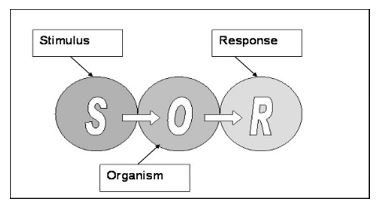
At its simplest, the SOR model looks like this:

Good and evil are alive and well

~~~

Blog Post D2: Theory of trauma impacts on self-criticism

By Jim Byrne, Doctor of Counselling

26th June 2021

~~~

The Good and Bad Inner Critic

Copyright (c) Jim Byrne, 2021

~~~

Introduction

Today, I completed Appendix D to my newly updated and expanded book on trauma recovery***, and it struck me just how far I have actually come since the heady (but simplistic) days of attributing the emotional upsets of counselling clients to their “belief systems”.

In Appendix D, I write about the client’s emotions, and various ways of processing their emotional problems through their visual and kinaesthetic channels; and then I move on to look in detail at their “feelings/attitudes/values/beliefs” about themselves – which cannot be boiled down to “mere cognitions”!

So instead of a “mere” belief system, it seems humans have an integrated ‘apparatus’ for perceiving-feeling-thinking, all in one “grasp” of the brain-mind.

Appendix D begins like this:

Preamble

Trauma victims are often very harsh in their judgements of themselves.  They take this harshness over from their abusers or victimizers.

~~~

We each have a legitimate (Good) Inner Critic (or conscience, super-ego, or Parent ego state) which helps us to stay on the moral and legal straight and narrow path through life.

But we each also have an illegitimate, unjustified, and damaging (Bad) Inner Critic, which is based on an excessively harsh conscience; or self-hatred; internalized from others.

I call the legitimate (Good) Inner Critic your “Good Wolf” state, after the traditional view of the Native American Cherokee people.  They believed that we each have a war going on inside of us, between two Wolves; a Good Wolf and a Bad Wolf; and that the Wolf that wins is the one we feed.  So we need to make sure we feed our moral, loving, kind, compassionate, charitable, but also self-assertive Good Wolf; and to starve our immoral, hateful, hurtful and aggressive Bad Wolf.  (This has echoes of the European Christian view of the inner states of (1) sin [the Devil], and (2) the state of grace [or the indwelling Holy Spirit]. It also has echoes of Sigmund Freud’s distinction between the inner urges he called Thanatos [the Death urge] and Eros [the Love/Life urge]).

So our ‘Inner Critic’ ranges from moderate and moral – (which is the Good Wolf state) – to harsh and immoral (which is the Bad Wold state).

Therefore, our Inner Critic can be justified or unjustified.  (The only cases where it is justified all have to do with legitimate transgressions of moral rules or justified laws (or health and safety issues).

The inner critic is not justified in criticizing harshly your efficiency or effectiveness, or general judgements in life.

It also is not justified in blaming you for being victimized; or describing you as worthless or ugly, etc.

When we harshly criticize ourselves, and put ourselves down – especially when the criticism is unjustified, exaggerated or inappropriate – this damages our sense of self-esteem and self-confidence; and makes us miserably unhappy.

… End of extract. …

~~~

Later in Appendix D I present a table in which I list the features of the client’s “Bad Inner Critic”; their “Good Inner Critic (or conscience); and their “Inner Coach/Mentor”.

This goes way beyond the amoralism of Albert Ellis, Fritz Perls, Carl Rogers and so many other of the post-war theorists of counselling psychology.

~~~

That’s all for now.

Best wishes,

Jim

Dr Jim Byrne, Doctor of Counselling

ABC Coaching and Counselling Services

Email: Dr Jim Byrne.***

~~~

Insane Psychiatric Medicine

~~~

Insane Medicine: How the Mental Health Industry Creates Damaging Treatment Traps and How You Can Escape Them

Sami Timimi, MDBy

Sami Timimi, MD

October 12, 2020

Editor’s Note: Over the next several months, Mad in America will publish a serialized version of Sami Timimi’s book, Insane Medicine. In this blog, he introduces the book. Each Monday, a new section of the book will be published, and all chapters will be archived here. 

Preface: Why I Wrote This Book and What It’s About

At the end of a discussion after a teaching session, a psychiatric trainee colleague of mine made a bet with me that within 25 years there will be a physical test for schizophrenia. As I had progressed through training, the scales had been falling from my eyes. I was becoming increasingly suspicious of the promises of milk and honey for psychiatric technology being just around the corner.

It was the early 1990s, and “decade of the brain” talk was causing great excitement in our teachers. The fevered academic discourse pointing to this or that region of the brain or this and that neurotransmitter receptor existed in a different world to the psychiatric wards I worked on. Patients, all too often, were objects of fear, loathing, or paternalistic sympathy. Psychiatrists acted as glorified pharmacists usually adding medications and diagnoses to someone’s health records, while nurses struggled to deal with the emotional intensity of these deeply untherapeutic environments by trying to work out which patients had behavioural problems (and were therefore “personality disorders”) in order to lobby for their discharge and which ones were “ill” and therefore merited sympathy and more medication.

To survive as a psychiatrist, several of my senior supervisors warned me, I needed to learn how to cut off my emotions when dealing with patients. To be objective, I had to become un-empathic. I was never able to master that skill.

Those 25 years have come and gone. No test has emerged, not for schizophrenia or any other so-called psychiatric diagnosis. I became a child psychiatrist to escape the oppressive world of faux diagnosis and brain numbing sedatives, only for child psychiatry to get sucked into the pseudoscience scientism and for children to become the latest victims of the cruel, violent, and dehumanising mental health systems we created.

I have written this book as a warning to all who are contemplating engaging in mental health services, have engaged with mental health services, or continue to engage with mental health services, and to those who love and care for them.

…End of extract…

…For more, please go to What’s wrong with psychiatric medicine.***

~~~


Scientific relaxation for health and happiness

Occasional Blog Post:

By Dr Jim Byrne

17th October 2020 – Updated on 16th March 2024

The Many Negative Effects of Cumulative Physical Tension

– including emotional and behavioural problems; and how to resolve them

~~~

Introduction

Jim.Nata.Couples.pg.jpg.w300h245If human beings did not have bodies, most of our problems would be over. (Or if we had bodies, but no external Demanding and Stressing Environment; that would also leave us feeling blissful). And yet, we live in cultures that keep insisting that our problems are essentially mental; essentially individual; but paradoxically fixable with all kinds of consumer goods and material things, like ‘retail therapy’; antidepressants; drugs for anxiety or hyperactivity; alcohol; foreign holidays; movies; flashy clothing; surgery; electroshock treatment; a new house; a big-f***er car; plastic surgery; sweets; chocolates; snorting cocaine; and on, and on, and on.

But what if most of the more serious consequences of stress and strain could be solved by a self-help form of scientific relaxation; which you can do in your own home; in a matter of minutes each day; at no financial cost whatsoever; resulting in a feeling of mental and physical bliss?  What then?  (It seems to me that it would be decried, denied, blown off – which seems to be what has happened, in wider society, to a most wonderful system of scientific relaxation, developed over a period of 70 years of research, by Dr Edmund Jacobson).

~~~

The system; the benefits; and how to do it

Nata-Lifestyle-coach8Renata Taylor-Byrne has recently completed the best part of a year of research on the history and current status of Dr Jacobson’s Progressive Muscle Relaxation (PMR) system; including the known benefits (in fixing all kinds of medical, emotional and personal performance problems); and guidance on how to practice this system in your own home, quickly and easily; to gain enormously.
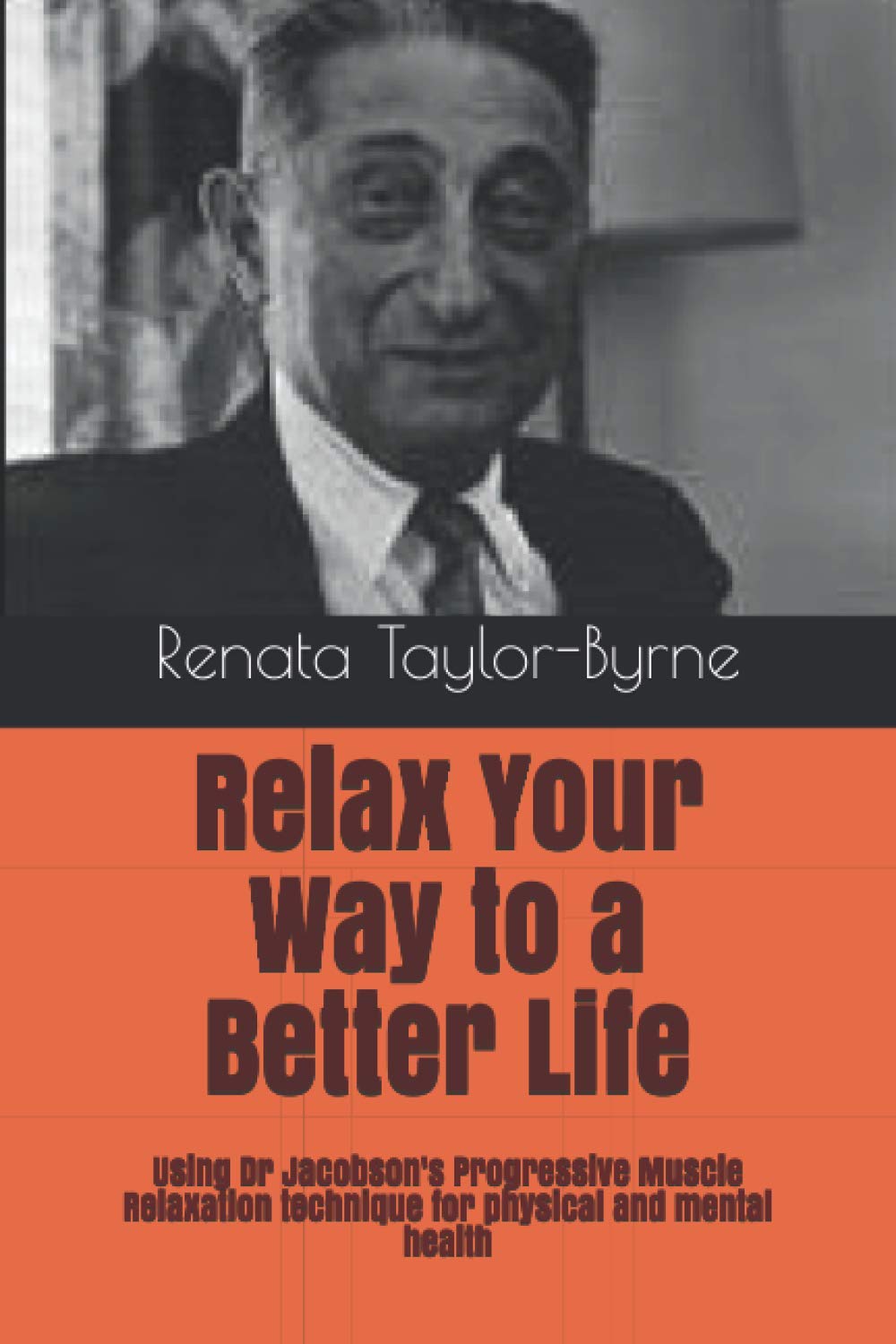
Here are the details:

1, 1, A, Cover, Jacobson, Front 2024Relax Your Way to a Better Life: Using Dr Jacobson’s Progressive muscle relaxation technique for physical and mental health

By Renata Taylor-Byrne

Edited by Dr Jim Byrne

And published by: The Institute for E-CENT Publications, September 2020

~~~

~~~

Scientific Relaxation and common-sense ‘relaxation’

Scientific relaxation is very different from slouching on a couch; or lying on a beach; or knocking out your conscience with lots of alcohol.  Scientific relaxation involves consciously tensing and relaxing individual pairs of muscles in order to learn the difference in the feeling between the two states.  After a while, you become quite conscious of the difference, and can consciously decide to switch off the unnecessary tension, and slip into a sweet feeling of relaxation, even in work, or in the wider world.  Later still, this feeling for the difference between tension and relaxation becomes non-conscious, habitual, and automatic.

But first you need to learn how to do it.

And that process is described in Chapter 10 of Renata’s book.***

You can get more information about the content of her book here: 

Relax Your Way to a Better Life.***

For an immediate grasp of the overall shape of her book, please see the Contents page, which follows:

Contents

Preface        v

Chapter 1: Introduction  1

Chapter 2: How tension builds up in your body each day         7

Chapter 3: The different ways that excessive tension affects your body         13

Chapter 4:  How progressive muscle relaxation cures insomnia 19

Chapter 5: Reducing anxiety in sports & public performance roles     27

Chapter 6:  PMR helps children and adults to handle test anxiety      35

Chapter 7: How progressive muscle relaxation makes pain more manageable 41

Chapter 8: Reducing anxiety in various contexts, using progressive muscle relaxation   49

Chapter 9: How progressive muscle relaxation (PMR) fits into a healthy and flourishing lifestyle        59

Chapter 10: How to practice PMR at home  67

Chapter 11: Conclusion  73

References   77

Appendix A: An Overview of Progressive Muscle Relaxation  85

Appendix B: How to establish the relaxation habit 107

Appendix C: The importance of diaphragmatic breathing         119

Appendix D: Some background on Jacobson’s electrical measurement of physical tension          125

Endnotes     131

~~~

You can get more information about the content of her book here:  Relax Your Way to a Better Life.***

~~~

MensGroup2That’s all for today.

Best wishes,

Jim

Dr Jim Byrne, Doctor of Counselling (University of Manchester, 2002-2009)

~~~

Postscript – 16th March 2024 – How I benefitted from doing PMR

I – Jim Byrne – began doing nightly Progressive Muscle Relaxation, every single night, 24 months ago. About halfway through that period I noticed a fundamental personality shift in myself, from introverted to extraverted; and from socially anxious to socially relaxed and at ease with others.

Throughout this period I have been more than usually happy, thought I cannot illustrate that as easily as I can illustrate my change to extraversion, less anxious, with a much stronger affiliative drive.

Try it and see. It will reward you handsomely if you put in the effort, and the self-discipline, to do our modified system of PMR every single night.

Relaxing is delicious. Get the book here: Relax Your Way to a Better Life.***

I hope you enjoy it!

Best wishes,

Jim Byrne, Doctor of Counselling, Hebden Bridge

~~~

Fictionalized autobiography of childhood trauma and adult damage

Blog Post: 16th August 2020

E-CENT Institute Blog

By Dr Jim Byrne

Books about childhood trauma – how to recover – how I recovered – and a fictionalized autobiography of childhood/manhood

Including an eBook about the life of an emotionally abused boy, and his struggle to become a loving man

~~~

Jim and the Buddha, 2I am aware of the principle of ‘concentration of power’ on our top priorities, which was popularized in the 1980s, by Dr Charles R. Hobbs, and re-presented in recent times by Garry Keller and Jay Papasan, in their book, ‘The One Thing’.  We are more likely to be successful if we focus on just a few important priorities.

Nevertheless, I have been switching back and forth between three books on Childhood Development, Trauma, and Recovery, for the past couple of months or more.

The three books in question are as follows:

~~~

Recovery from Childhood Trauma:

How I healed my heart and mind – and how you can heal yourself

By Dr Jim Byrne, Doctor of Counselling

Front cover,1Many people struggle with emotional distress, just below the level of conscious awareness, which mars their life chances, and limits their capacity for happy relationships. Much of this distress could and should be classified as post-traumatic stress disorder (PTSD); or emotional distress which follows on from a traumatic experience, which is too stressful (at the time of occurrence) to be processed into a coherent story.  And even more should be defined as Complex-PTSD, arising out of protracted child abuse in early childhood.
The author describes the main traumatic experiences that occurred in his childhood, which hung like a dark cloud over his emotional and relational life, up to the age of almost forty years or so.  He also describes the various therapeutic processes that he used to try to process his undigested childhood pain.  Chief among those strategies were the writing of his Story of Origins and his Story of Relationship, both of which are reproduced in this book, along with analysis and commentary. He also includes guidelines for the reader to do their own writing therapy on their own childhood trauma, which will greatly improve the quality of their emotional and relational lives.  And he emphasizes the importance of exercise and other body-based healing approaches. His hope is that the reader will use this book to become happier and healthier, and more at ease in their own skin; with a better prospect of moving forward into a more enjoyable future life.

For more information, please click this link.***

~~~

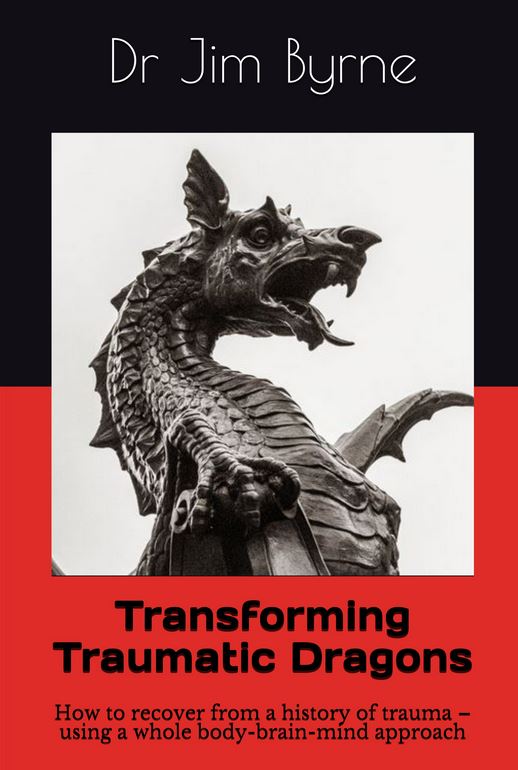
Transforming Traumatic Dragons:

How to recover from a history of trauma – using a whole body-brain-mind approach

By Jim Byrne, Doctor of Counselling

Revised, expanded and updated: June 2020

Front cover 2, Dragons Trauma book June 2020From Ancient Athens to Vietnam and Zambia, individual lives have been ruined by stress, strain, abuse and neglect. Madness, serious unhappiness and unworkable lives were most often the result.
Many common problems with physical and mental health are a result of childhood trauma, and/or being an adult who is abused by another adult.

Early childhood trauma (like physical and emotional abuse, and neglect), and other forms of prolonged trauma (like domestic abuse), affect the very structure of the human brain, and the behaviour of stress hormones in the body.

But the good news is this: It is possible to recover from all forms of trauma, given the right kind of approach. And this book offers you just such an approach to self-healing.

Dr Byrne discusses the following topics: What is trauma?  What is post-traumatic stress disorder?  What is Complex-PTSD?  How widespread is Complex-PTSD?  What are Adverse Childhood Experiences?  What are some solutions to Childhood Developmental Trauma or Complex-PTSD? The meaning and importance of the concept of Traumatic Dragons.

This book contains a comprehensive self-therapy program, to help you to heal your own traumatic wounds, from prolonged childhood abuse or neglect, or other forms of prolonged traumatic experiences.

If you are suffering from the aftermath of prolonged traumatic experiences, this book will be a great help to you. If you work slowly and methodologically through the program of self-healing, described in this book, you will gain by the calming down of your body, brain and mind; and the emergence of a sense of happiness and inner peace.

For more information, please click this link: Transforming Traumatic Dragons

~~~

But the third book – next – is the one I have chosen to prioritize, and it is now available on Amazon stores around the world.  This is it:

Fictionalized autobiography of an Irish Catholic boy: The autobiography of a traumatized child.

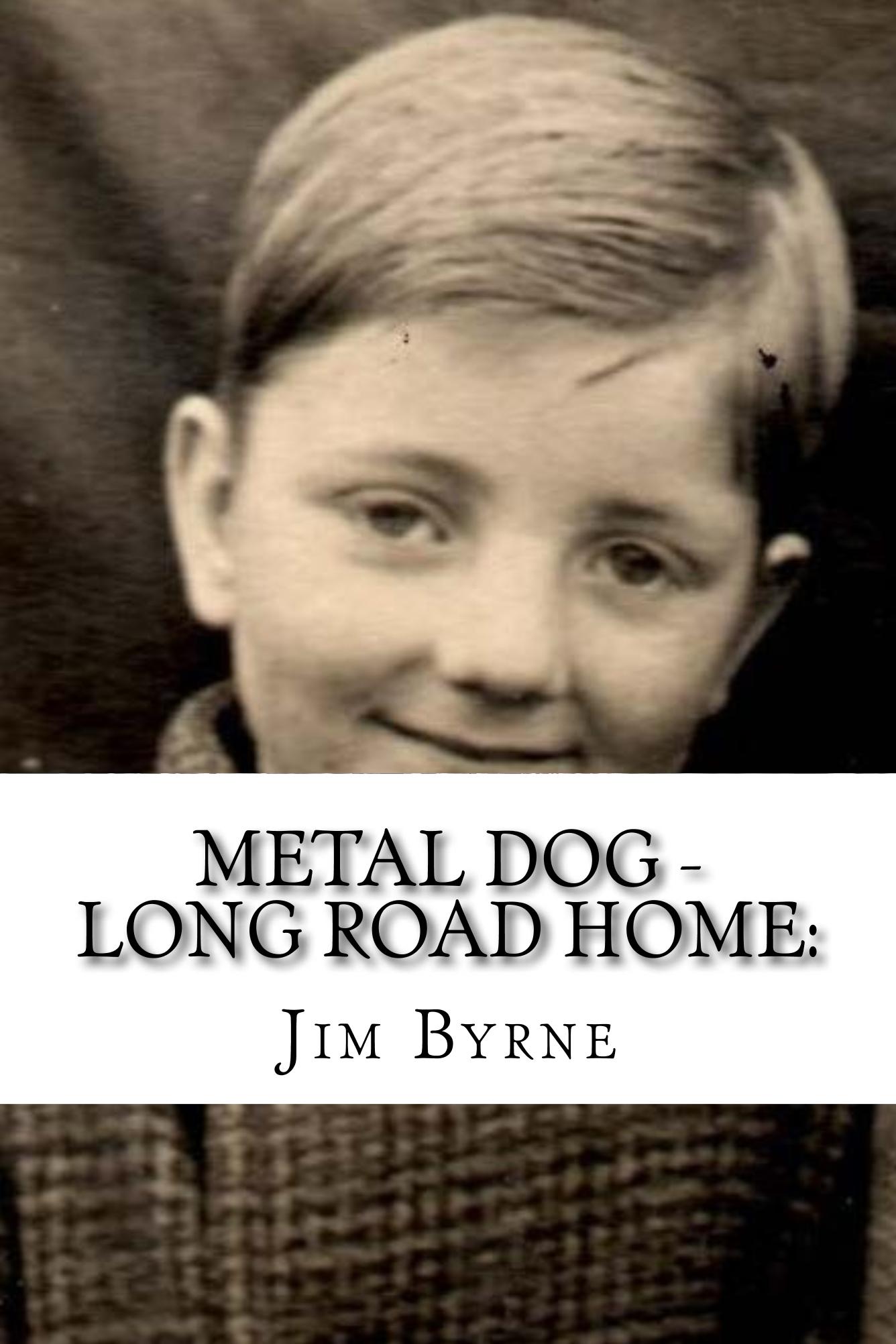
Title: Metal Dog – Long Road Home

By Jim Byrne (writing through his alter ego, Daniel O’Beeve)

~~~

Metal_Dog__Long_Roa_Cover_for_KindleThis is the fictionalized autobiography of Jim Byrne (writing through his alter ego, Daniel O’Beeve). None of the characters in this story should be confused with any real person, alive or dead!
Here is a brief extract, intended to give you a flavour of the quality of this personal (fictional!) story:

Extract: I went inside (the fish and chip shop in Blackpool), blinking the rain out of my eyes, and immediately recognized the leopard-skin coat and black fishnet tights on the raven-haired customer in front of me at the counter.  She lived in the house next to the one in which I was lodging.  I’d seen her come and go a few times as I sat at the table in the bay window, eating my breakfast or my evening meal.

She had the appearance of an actress or model.  Tall, elegant, heavily made-up, and she walked with a wiggle, in extremely high, black, patent leather stiletto heels.  As I stood behind her on the queue, she ordered cod and chips.  Then I ordered the same.  She turned to look at me and said, “Horrible weather!”

I agreed.

Her fish and chips were wrapped within seconds; she paid; and she headed for the door.

My fish and chips were wrapped next, and I followed suit.

I did not expect her to be waiting at the exit to speak to me…

For more, please click this link: Fictionalized autobiography – Metal Dog, Long Road back to near normality.***.

~~~

This is how I announced that book on LinkedIn today:

Childhood trauma and abuse: For the next 5 days, beginning on Sunday 16th August, this book will be available for FREE as a Kindle eBook. The author explores problems of attachment theory, affect regulation, personality adaptations, and childhood trauma – all in the context of a fictionalized autobiography which examines three different perspectives on the nature-nurture debate. Dr Jim Byrne has combined his experience of 22 years of dealing with clients with childhood abuse and neglect, and his hobby of reading psychological thrillers, to create a unique book…  Get your copy … …  Here: https://www.amazon.co.uk/Metal dog

Please take a look and see what you think. Do you think this fictionalized autobiography helps to expand or deepen your understanding of complex childhood trauma; or to deepen your empathy for victims of child abuse?

~~~

That’s all for today.

Best wishes,

Jim

Dr Jim Byrne

Doctor of Counselling

Attachment theory and complex childhood trauma

E-CENT Blog post – 1st July 2020: Updated on 9th December 2022

~~~

Trauma therapy, attachment theory, self-help resources, and the story of childhood trauma

How I worked on my own adverse childhood experiences, and used the resulting insights to help clients with childhood developmental trauma

By Jim Byrne, Doctor of Counselling, at The Institute for Emotive-Cognitive Embodied Narrative Therapy (E-CENT)

Copyright (c) Jim Byrne, July 2020/ December 2022

~~~

Childhood amnesia about traumatic abuseSome therapists look for the source of their clients’ upsets in the client’s beliefs, as if the client invented their own belief system, independently of their parents, teachers, religious institutions, and the mass media – and as if their current beliefs and attitudes were not strongly impacted by their current socioeconomic environment, and the current physical state of their body and brain.
Last week I worked with a depressed man, Frank (not his real name), over Skype (not the actual channel of communication) about the fact that he is involved in an unhappy marriage. He is 57 years old, on his third marriage, and his current wife seems to hate him, or strongly dislike him; is willing to tolerate being married to him; but does not want to have anything much to do with him – (even though they live together in a tiny house, and have done so for about five years).

Frank’s formulation of his problem was this: “I want Josie to love me, actively; and to engage in passionate sex on a frequent basis!”

To me, it seemed pretty clear this this was like somebody who lives in Africa, and knows Africa well, wanting snow on the equator in August; or a cool breeze in the Kalahari Desert at noon.  Totally unrealistic; and this should have been obvious to Frank if he was “thinking straight”.  (But then “thinking” is another story!)

We are unaware of our childhood traumasIn my view, Frank seemed to be acting out a childhood problem of insecure attachment to this mother: an inability to get close to his mother, and to get the kind of pleasure and comfort he needed from her, 55 years ago!
Many of my clients’ problems seem to track back to childhood attachment issues; or childhood trauma; both of which are outside of the awareness of the client.

~~~

I am currently expanding and updating my book on how to resolve complex trauma, caused by prolonged childhood abuse. The new title is this:

Transforming Traumatic Dragons:

How to recover from a history of trauma – using a whole body-brain-mind approach

1, A New Dragons Trauma book cover

This book began its life in an embryonic form in July 2011, as

E-CENT Paper No.13: Completing your past experiences of difficult events, perceptions, and painful emotions.  

The paper began like this:

Preface

“You cannot find peace by avoiding life”.  Virginia Woolf

~~~

“Whatever you resist persists”.  Werner Erhard

~~~

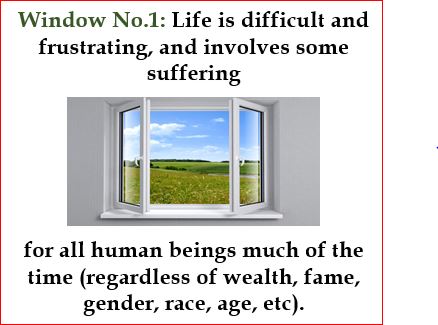
The core of the theory and practice of Emotive-Cognitive Embodied Narrative Therapy (E-CENT) is built around the concept of “reframing your experience” of life, so that it will show up in a more tolerable and bearable way than if you frame it unrealistically, illogically and/or unreasonably.  Normally the client knows what the problem is.  It is available to their conscious awareness.  And the E-CENT counsellor encourages them to look at it through a variety of ‘lenses’ or ‘windows’, so they can see it differently. (Byrne, 2009b). For example:

Window1

On the other hand, sometimes a client may have a problem buried in their past, about which they know nothing, and this buried problem – this ‘denied pain’ – is the main driver of their current depression, anxiety, panic, or anger.  With these kinds of archaic problems of repression, we use techniques related to the concept of “digging up” and “completing” that archaic experience; of “digesting it”; so it can be filed away in an inactive file, in the background of their life, where it cannot cause them any more psychological problems.

However, these two processes cannot be totally separated.  Humans are interpreting-beings. We cannot see our experience directly, and we cannot complete our experience of some kind of ‘objective reality’. In fact, when we are trying to complete an experience, we either see it through an ‘empowering lens’ or a ‘depowering lens’.  Therefore, we must never fail to engage in empowering processes of reframing our experience, as we are completing it. (This is especially true when dealing with old traumatic experiences).

~~~

drjim-counsellor9Then, in 2016, I produced a book, entitled ‘Facing and Defeating Your Emotional Dragons’; which used the processes of ‘reframing experiences’ and ‘completion’, with the proviso that the reframing process must be mastered by the client before they ever attempt the completion process, in order to avoid re-traumatizing themselves.
I am now (in June/July 2020) updating that book, and expanding it, to take account of the insights and therapeutic processes of Dr Bessel van der Kolk (The Body Keeps the Score), combined with other influences, and my own more recent clinical experience.

The title of this revised and expanded book is this:

Transforming Traumatic Dragons:

How to recover from a history of trauma – using a whole body-brain-mind approach.

And you can read about the content of this book here:

https://abc-bookstore.com/how-to-resolve-childhood-developmental-trauma/

~~~

PS: I would also recommend that you take a look at the following, related information pages:

Recovery from Childhood Trauma: How I healed my heart and mind – and how you can heal yourself.

And also:

Newly released on 15th November 2022

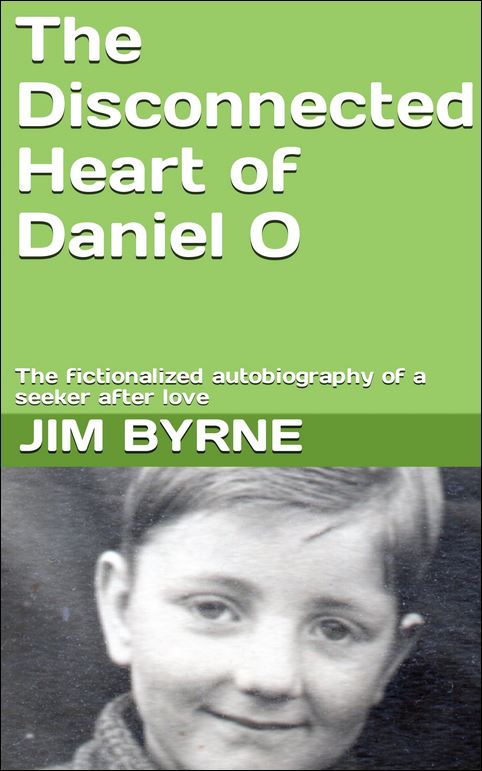
The Disconnected Heart of Daniel O:

The fictionalized autobiography of a seeker after love

~~~

“How I healed my (mother-inflicted) childhood emotional wounds, and how you can heal yours!”

~~~

A fictionalized-factual life story, combined with a subjective psychological self-analysis of developmental trauma disorder

~~~

By Jim Byrne, Doctor of Counselling – (and his alter ego, Daniel O’Beeve)

~~~

Kindle coverThis book is about one man’s journey away from his homeland and his emotionally barren family and priest-dominated culture, to a place where he might find love, acceptance and personal liberation.
Daniel’s heart-wrenching journey to freedom is like a detective novel, a psychological thriller, and a science fiction adventure, all rolled into one. He shows the reader how to heal their own psychological wounds from childhood, and especially from their relationship with an unskillful or damaged mother.

…For more information, and a substantial extract from the book, please click this link…

~~~

Reader Review:

“I read this book in three evenings. It’s a wonderfully insightful trawl through the complexities of the initial relationship bond between a damaged mother and her avoidant and dissociating son, by the seer Dr Jim Byrne.  

“The book explores the dynamics of his own relationship with his mother in a way that is accessible and tangible, which is generalizable to the life of the reader.  Many readers will be able to relate to this fictionalized story which explores early attachment trauma(s) and how we spend the rest of our lives trying to come to terms with what happened to us as a child. And the bonus is a final chapter which describes how to heal your own ‘mother wound’.”

Brian Ingersoll-Trent, Liverpool. December 7th 2022

~~~

…For more information, and a substantial extract from the book, please click this link…

~~~

~~~

ecent logoThat’s all for now.

Best wishes,

Jim

Dr Jim Byrne

Doctor of Counselling

Executive Director of the Institute for E-CENT

~~~

Emotive-cognitive-embodied therapy versus REBT/CBT

~~~

Blog post: 15th June 2020

Distinguishing Emotive-Cognitive Embodied Narrative Therapy (E-CENT) from REBT/CBT

By Dr Jim Byrne

~~~

Preamble

Jim and the Buddha, 2The most fundamental difference between E-CENT theory and REBT/CBT theory is their models of human disturbance.

Albert Ellis, the creator of REBT, and the grandfather of general CBT, rejected the simple Stimulus-Organism-Response (SOR) model of neobehaviourism, and Freud’s It/Ego/Superego, and substituted his own simple ABC model.

The simple SOR model assumed that, every time a stimulus impacted an organism, an adaptive response, based upon prior conditioning, was emitted or produced.  If a person saw something which had previously frightened them, then they would respond with fear. But if the same stimulus had previously angered them, then they would respond with anger.

Human-emotionThe simple ABC model dumped the role of experience, conditioning, and habit formation, and replaced those experiential psychological processes with a single concept: Beliefs! 
I have produced an extensive critique of the ABC model of REBT, in my main book on REBT, which is A Major Critique of REBT’. What follows is a brief extract from Chapter 2 of that book:

~~~

Introduction

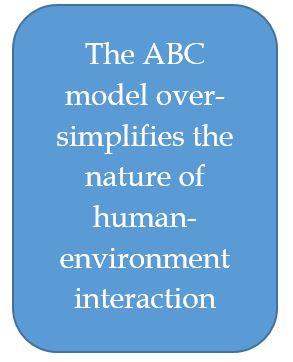
The ABC model oversimplifiesLet us now take a look at the ABC model of REBT – which is the core model that not only determines the shape of each intervention by an REBT therapist, but which also structures the entire 45 minutes of time spent with each client.
To repeat what was said above, the ABC model is normally presented like this:

# The ‘A’ stands for an Activating event, or stimulus, which results in some kind of response from an individual.

# The ‘B’ stands for the Belief system of the individual (which includes distinctions to do with whether the individual is:

(a): Being (1) ‘demanding’; versus (2) merely ‘preferring’ something;

(b): Expressing (1) ‘awfulizing’ (which means [in REBT – but not in the Oxford English Dictionary] describing something as totally bad); versus (2) merely saying something is some small degree of badness;

(c): Implying (1) that they ‘cannot stand’ something at all; versus (2) the idea that it is merely difficult to stand it; or:

(d): Engaging in (1) condemning or damning of self, others or the world; versus (2) merely being critical of their own behaviour, the behaviour of others, and/or some features of the world/reality).

# The ‘C’ stands for the Consequent emotions (and/or behaviours) that are assumed to arise out of the interaction of the ‘A’ multiplied by the ‘B’ above.  At least, that is a form of the ABC model, which arose at some point in the evolution of the theory.  This interactional model is expressed by Windy Dryden (1999) like this: “…the C’s (consequences – JB) … follow from irrational beliefs (iB’s – JB) about negative A’s (or negative activating events – JB)…”. (Pages 7-8)[1].

But this is a construction which is honoured more in the breach than in the observance by Albert Ellis (and perhaps many other therapists as well).  Throughout the whole of his career, as illustrated below, Albert Ellis tended to imply that no Activating event (A) could cause a client to feel anything (at point C) – unless they were hit by a brick or a baseball bat.  This is an implicit denial of the strength, power and aversive influence of all activating events (A’s), leaving the B (or irrational beliefs) to largely (or almost exclusively) account for the client’s disturbance.  And the way Ellis normally expresses this construction, when under pressure to adhere to the interactional model, is this: “Although A’s often seem to directly ‘cause’ or contribute to C’s, this is rarely true, because B’s normally serve as important mediators between A’s and C’s, and therefore (the B’s) more directly ‘cause’ or ‘create’ C’s…”[2].  Thus Ellis hangs on to the idea that the client’s beliefs (B) are the real culprit – while seeming to accept the interaction of the A’s and B’s.  For Ellis, it is a sine qua non (or an essential condition) of human disturbance that clients, in fact, disturb themselves! (What a gift he handed to the immoral forces of the world! The exploiters, abusers and oppressors!)

In Ellis’s own words: “When I started to get disillusioned with psychoanalysis I reread philosophy and was reminded of the constructivist notion that Epictetus had proposed 2,000 years ago: ‘People are disturbed not by events that happen to them, but by their view of them’.” (Quoted in Epstein, R. [2001])[3].

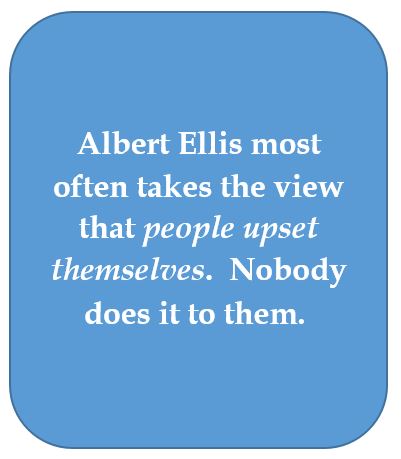
Albert Ellis blames the client for upsetsFrom this position, Ellis often takes the view that people upset themselves.  Nobody does it to them.  “How can anybody make you feel anything?” he will demand to know.
But he is not always consistent.  Sometimes he will say it slightly differently, like this:

“People don’t just get upset. They contribute to their upsetness”, which sounds more like the ‘interactional model’ – which says, A (or activating event) multiplied by B (or the person’s belief) equals C (or their consequent emotional response). But then he adds his escape hatch: “They always have the power to think, and to think about their thinking, and to think about thinking about their thinking, which the goddamn dolphin, as far as we know, can’t do.” (Quote from Epstein, 2001).

In other words, although they ‘only contribute’ to their upsetness, about some Activating event; nevertheless, since they have the power to think their way out of their upsetness, they are obviously still upsetting themselves (with their ‘goddamned irrational beliefs’) if they continue to be upset!  QED!

Albert Ellis absolves external pressures from human disturbance

Here is yet another Ellis formulation: “People condition themselves to feel disturbed, rather than being conditioned by external sources.” (Ellis, 1979)[4].  (Remember, in Chapter 1 above, I mentioned that Ellis acknowledged internal and external conditioning.  Now he dumps the external conditioning completely.  Such inconsistencies are a hallmark of Albert Ellis’s reasoning!  He clearly does not have a consistent model of the human brain-mind-environment complexity in his mind, at least not available to his conscious inspection!)

And, finally, here is a summary of Ellis’s view from Corey, (2001):

“…human beings are largely responsible for creating their own emotional reactions and disturbances.  Showing people how they can change their irrational beliefs that directly ‘cause’ their disturbed emotional consequences is the heart of REBT (Ellis, 1998[5], 1999[6]; Ellis and Dryden, 1997[7]; Ellis, Gordon, Neenan and Palmer, 1997[8]; Ellis and Harper, 1997[9])”.  (From Corey, 2001, page 300)[10].

Albert Ellis's false view of human disturbance

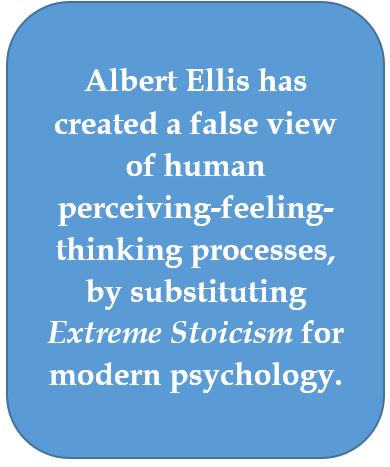
As I will demonstrate below, Albert Ellis has created a completely false view of human perceiving-feeling-thinking processes, by substituting an extreme Stoical philosophical proposition (which is false to facts) for any and all modern psychologies (with the possible exception of Adlerian therapy, which claims that our emotional reactions and lifestyle are ‘cognitively created’. See Corey, 2001, page 298).

This view (from Ellis and Epictetus) contradicts the modern neuroscience and interpersonal neuropsychology perspectives, which show emotion as innate, and underpinning all emotive-cognitive processes. (Siegel 2015; Panksepp, 1998; Hill 2015).

~~~

For more of my critique of REBT, please see:

  1. A Major Critique of REBT: Revealing the many errors in the foundations of Rational Emotive Behaviour Therapy

~~~

~~~

  1. Discounting Our Bodies: A brief, critical review of REBT’s flaws. (If you want to know the essence of our critique of REBT, but you don’t want to have to read 500+ pages, then this 150 page summary should appeal to you).

~~~

~~~

  1. The Amoralism of Rational Emotive Behaviour Therapy (REBT): The mishandling of self-acceptance and unfairness issues by Albert Ellis

~~~

~~~

  1. Albert Ellis and the Unhappy Golfer: A critique of the simplistic ABC model of REBT

~~~

~~~

A more comprehensive model of human disturbance

By contrast with the simplistic ABC model of REBT/CBT, we in E-CENT counselling theory have created a much more realistic, Holistic Stimulus-Organism-Response model.

The first step in creating this model involved “adding back the body” to our models of human disturbance.  In the ABC model of REBT/CBT, there is no body.  A person is just “a belief-machine”.

But in reality, our emotions are housed in our physical bodies/ brains/ minds; and socialized into our bodies/ brains/ minds.

Over time, I refined this body-brain-mind model of human disturbance, and this is how I wrote about it in our book on Lifestyle Counselling and Coaching for the Whole Person:

8.3(b): Elucidation

The elucidation stage of E-CENT counsellingThere are a number of models that I use for the purpose of elucidating the client’s concerns, dilemmas, goals, etc.
Chief among them is our own holistic version of the Stimulus-Organism-Response (or Holistic-SOR) model.

The original SOR model (created by the neo-behaviourists) suggested that, when an animal (or human) notices a stimulus (S), it outputs a response (R), because of the way the organism (O) processes the stimulus.

Figure 8.1: The classic S>O>R model:

the simple SOR model

That original SOR model of neo-behaviourism was dumped by Dr Albert Ellis, the creator of Rational Emotive Behaviour Therapy (REBT), and replaced by the simple ABC model, in which the client is assumed to be always and only upset because of their ‘irrational beliefs’.  (And Freud’s ‘ABCs’ were no better, in that he implied that when something happens [let’s call it an ‘A’, or activating event], the client responds with their own phantasy [let’s call it a ‘B’, or belief], which upsets them [at point C – consequence]: though Freud did not use that ‘ABC’ lettering system)

Aaron Tim Beck (despite being a medical doctor, and theoretically aware of the importance of the human body) also adopted this simple ABC model. (Beck 1976).

So one of the main contributions of E-CENT counselling has been ‘adding back the body’ to the client; and accepting that the client’s body-mind-environment-whole is implicated in all of their emotional and behavioural states.

In the process we developed a more holistic version of the Stimulus-Organism- Response model. (See Figure 8.2 below)

In the simple, classical SOR model, an incoming stimulus (S) – (which is a sensed experience) – impacts upon the nervous system of the organism (O) – (or person, in our case) – causing a reactive response (R) to be outputted (or generated), to cope with the stimulus (or incoming experience).

In the early stages of our explorations, after looking at Freud and Ellis – on the ABC model and the Experience-Phantasy-Neurosis model – we turned our attention to the Parent-Adult-Child (PAC) model of TA, plus this simple, classic SOR model.

But then we began to ask ourselves what factors are most likely to affect the capacity for a human organism to be able to handle difficult incoming stimuli, or activating events.  We came up with an extensive list, which includes:

Diet: (meaning balanced, healthy, or otherwise).  (Does the individual/ organism have enough blood-glucose to be able to process the incoming stimulus, physically and mentally?)

Exercise: (meaning regular physical exercise designed to reduce stress, versus a sedentary lifestyle)[11]

Self-talk, scripts, frames and schemas: (Including conscious and/or non-conscious stories and narratives/ thinking-feeling states/ self-signalling/ attitudinizing / framing, etc.  Plus other culturally shaped beliefs and attitudes, expectations, prophesies, etc.  Plus non-narrativized experiences stored in the form of schemas and frames, etc.)

Relaxation: (or release from muscle tension and anxiety, versus tension and anxiety);

Family history: (including attachment styles [secure or insecure]; childhood trauma; and personality adaptations, etc.);

Emotional needs: (including deficits and/or satisfactions);

Character and temperament: (as in Myers-Briggs or Keirsey-Bates)[12];

Environmental stressors: (including home environment, work situation, economic circumstances, and so on);

Sleep pattern; and the balance between work, rest and play.

~~~

By keeping our focus on the fact that the client is a complex, socialized body-brain-mind; steeped in storied- (or narrativized-) experiences (plus non-storied experiences) of concrete experiences in a concrete world; and living in a complex relationship to an external social environment – which is often hostile and unsupportive, resulting in stress-induced over-arousal of the entire body-brain-mind – we never fall into the trap of foolishly asking the client: “What do you think you are telling yourself in order to cause your own problem?” 

And we do not foolishly tell the client that the thoughts which (in reality, very often) follow on from their emotional experiences are causing those emotional experiences!

~~~

We focus on the client’s story and the client’s physical existence, both with roughly equal, but variable, emphasis.  Sometimes the story needs most attention, and sometimes the state of the body-brain-mind, in terms of diet, exercise, etc., is more important.

Traditional medical doctors were guilty of separating the body from the mind, and trying to treat the body as a ‘faulty machine’ – which was in line with Newtonian mechanics of the nineteenth century, which lasted well into the twentieth century and beyond.

Sigmund Freud, as a trained neurologist and MD, came out of that tradition and began the process of moving towards some kind of appreciation of the mind.

However, many generations of counsellors and psychotherapists have gone too far in this direction, and forgot all about the body.

Some modern medical doctors are beginning to realize their original error.

Here’s how Dr Ron Anderson, Chairman of the Board of the Texas Department of Health, describes his aim for all the doctors he influences:


“I try to have people understand wholeness if I can, because if you don’t understand the mind/body connection, you start off on the wrong premise. 

You also have to understand the person within their family and community because this is where people live”.[13] 


~~~

Using the Holistic SOR model

Figure 8.2 below shows how we present the holistic SOR model for our clients.

Holistic-SOR-Model

Figure 8.2: The E-CENT holistic SOR model

As indicated in Figure 8.2, E-CENT theory takes a holistic view of the client as a social-body-mind, with a habit-based character and temperament, living in a particular social and physical environment, with stressors and supports.

The client has a personal history which is unique to them; plus some social shaping that extends to their family, and some to their community; some to their nation/ race/ gender, etc.

This illustration should be read as follows: Column 1 – ‘S’ = (or equals) a stimulus, which, when experienced by an O = Organism (in our case a human), may activate or interact with any of the factors listed in column 2; and this will produce an R = Response, as shown in column 3.

To be more precise: The holistic SOR model states that a client (a person) responds at point ‘R’, to a (negative or positive) stimulus at point ‘S’, on the basis of the current state of their social-body-mind.

How well rested are they?

How high or low is their blood-sugar level (which is related to diet)?

How well connected are they to significant others (which is a measure of social support)?

How much conflict do they have at home or at work?

What other pressures are bearing down upon them (e.g. from their socio-economic circumstances; physical health; home/ housing; work/ income; security/ insecurity; etc.)

And how emotionally intelligent are they? (Emotional intelligence is, of course, learned, and can be re-learned!)

Within the Holistic-SOR model (in Figure 8.2 above), in the middle column, what we are aiming to do is to construct a balance sheet (in our heads) of the pressures bearing down on the client (person), and the coping resources that they have for dealing with those pressures.

~~~

So this is a historical-social-stress model. It is not a purely ‘cognitive distortion’ model; nor a purely ‘biological/ sexual urges’ model; nor a purely ‘prizing and listening’ model.

~~~

For more insights into this whole body-brain-mind approach to emotive-cognitive- embodied therapy, please take a look at the page of information about Lifestyle Counselling and Coaching for the whole Person.***

~~~

That’s all for now.

Best wishes.

Jim

Dr Jim Byrne

Doctor of Counselling

Fellow of the International Society of Professional Counsellors (FISPC)

ABC Coaching and Counselling Services

~~~

The Institute for E-CENT Counselling

~~~

ABC Bookstore Online

~~~

Endnotes

[1] Dryden, W. (1999) Rational Emotive Behavioural Counselling in Action.  Second edition.  London: Sage Publications.

[2] Ellis, A. and Dryden, W. (1999) The Practice of REBT.  Second edition.  London: Free Association Books. Page 9.

[3] Epstein, R. (2001) The Prince of Reason: An interview with Albert Ellis, developer of rational emotive behaviour therapy. Online blog article and interview. Psychology Today online blog article https://www.psychologytoday.com/articles/200101/the-prince-reason

[4] Ellis, A. (1979). Rejoinder: Elegant and inelegant RET. In A. Ellis & J.M. Whiteley (eds.). Theoretical and empirical foundations of rational-emotive therapy (pp. 240–271). Monterey, CA: Brooks/Cole.

[5] Ellis, A. (1998) How to Control your Anxiety before it Controls You.  Secaucus, NJ: Carol Publishing Group.

[6] Ellis, A. (1999) How to make yourself happy and remarkably less disturbable.  San Luis Obispo, CA: Impact.

[7] Ellis, A. and Dryden, W. (1997) The Practice of Rational Emotive Therapy (Revised edition).  New York: Springer.

[8] Ellis, A., Gordon, J., Neenan, M., and Palmer, S. (1997) Stress Counselling.  London: Cassell.

[9] Ellis, A. and Harper, R. (1997) A Guide to Rational Living.  Third Edition. Hollywood, CA: Wilshire.

[10] Corey, G. (2001) Theory and Practice of Counselling and Psychotherapy. Sixth Edition.  Belmont, CA: Brooks/Cole.

[11] The British National Health Service (NHS) supports the view that exercise is good for mood disorders, like anxiety and depression.  Here’s their comment specifically on depression:

“Exercise for depression

“Being depressed can leave you feeling low in energy, which might put you off being more active.

“Regular exercise can boost your mood if you have depression, and it’s especially useful for people with mild to moderate depression.

‘Any type of exercise is useful, as long as it suits you and you do enough of it,’ says Dr Alan Cohen, a GP with a special interest in mental health. ‘Exercise should be something you enjoy; otherwise, it will be hard to find the motivation to do it regularly.’

“How often do you need to exercise?

“To stay healthy, adults should do 150 minutes of moderate-intensity activity every week.”  In E-CENT we recommend 30 minutes of brisk walking every day, minimum. Source:   http://www.nhs.uk/conditions/stress-anxiety-depression/pages/ exercise- for- depression.aspx) Accessed: 23rd February 2016.

~~~

[12] Keirsey, D. and Bates, M. (1984) Please Understand Me: Character and temperament types. Fifth edition. Del Mar, CA: Prometheus Nemesis Book Company.

[13] ‘The healing environment’: An interview with Dr Ron Anderson, in Bill Moyers’ (1995) book: Healing and The Mind.  New York: Doubleday. Page 25.

~~~

The amazing power of well-managed sleep to cure insomnia

Renata’s Blog Post

30th April 2020

Updated on 26th December 2025

Copyright © Renata Taylor-Byrne 2020

~~~

Do you want to feel better tomorrow morning, at no cost?

The amazing power of well-managed sleep to transform your life

~~~

By Renata Taylor-Byrne, Lifestyle Coach-Counsellor

~~~

Full cover JPEG, 21 April 2019

Introduction

Sleep has a huge impact on your life, in ways you may not even notice!

Let me illustrate that claim for you with a quote from an outstanding sleep scientist:

“You may find it surprising to learn that vehicle accidents caused by drowsy driving exceed those caused by alcohol and drugs combined. Drowsy driving is worse than driving drunk.

“This may seem like a controversial or irresponsible thing to say, and I do not wish to trivialise the lamentable act of drunk driving by any means. Yet my statement is true for the following simple reason: drunk drivers are often late in breaking (applying their brakes!) and late in making evasive manoeuvres.

“But when you fall asleep, or have a microsleep (which means momentary unconsciousness), you stop reacting altogether.

“A person who experiences a microsleep, or who has fallen asleep at the wheel. does not brake at all, nor do they make any attempt to avoid an accident”.

 (Matthew Walker, Why We Sleep, 2017) [2]

~~~

Front cover, sleep book, Feb 2019Matthew Walker is an expert in sleep science and has strong opinions about the necessity for sufficient sleep before people set out driving.  His reason is the insight that many people sometimes fall asleep for a couple of moments whilst driving, if they are sleep deprived.  These are called ‘micro-sleeps’.

If you are a driver: Have you ever been aware of having a micro-sleep whilst driving – that means a split-second break in concentration (because you are unconscious!)? If so, you may recall that this happened because you were tired and your eyelids closed or half-shut for a few seconds.

What are the known, measured implications of these kinds of micro-sleeps?

Walker gives the example of micro-sleeping while driving at 30 miles an hour:

This is the bottom line:

“A two second microsleep at 30 mph with a modest angle of drift can result in your vehicle transitioning entirely from one lane to the next. This includes into oncoming traffic. Should you do it at 60 mph, it may be the last microsleep you ever have”. (Page 134)

~~~

For more, go to the Sleep Books section of the ABC Bookstore…***

Sleep education

Were you taught the importance of getting enough sleep when you were a child; at home or in school? Maybe teachers can’t cover everything, but what about doctors?  Have you ever been coached by your GP regarding the importance of sleep, and how it might be affecting your physical health or emotional well-being?

Dr Chris Winter (2017)[1] writes about one researcher, Raymond Rosen, who discovered that, in the four years of medical training given to trainee doctors (in America), most of them had received less than 2 hours of training in sleep science.

Full cover JPEG, 21 April 2019It seems there is a woeful lack of information available to the general public about the importance of sleep. It was not until 2000 that a major book on sleep science was published, and became somewhat popular (with the Book of the Month Club), thus making detailed knowledge from the basic science of sleep relatively widely available, perhaps for the first time.  (There have been earlier books on sleep science, but not so widely available).

This allowed readers to become aware of what happens to their bodies and minds if they don’t get enough sleep.

We now know, as a matter of scientific fact, that insufficient sleep can cause a range of physical and mental health problems; not the least of which is that it reduces your emotional intelligence, which seriously impacts your relationships and life chances.  (And there is a definite link to dementia!)

Renata’s Blog Post

30th April 2020

Copyright © Renata Taylor-Byrne 2020

~~~

For more, go to the Sleep Books section of the ABC Bookstore…***

Your sleep needs

Sleep-Habit-calloutIf you know you have problems getting to sleep, or staying asleep; or getting the kind of sleep which restores you, so you awake feeling refreshed, then this book is for you.

If you want to improve your sleep quantity and quality, you need to be able to stick to your commitment to change your sleep habits, and assertively alter them in the face of possible pressure from others.

As Dr Phil says, “This is when the rubber hits the road”. And so I have included a chapter on changing your sleep habits; as well as a chapter on how to cure insomnia!

Also, by way of a summary, there are eight key learning points about the ways in which lack of sleep can harm you, and the six crucial ways to protect your sleep are described.

Here is what the book gives you:  In summarized form, the most recent research findings about the crucial need for sleep, with full explanations of how to restore your sleep so that you get maximum nourishment and rest!

The main sleep destroyers are described and ways of protecting your sleep are examined.

If you follow the strategies in this book you will, firstly, experience deeper, more therapeutic sleep; and will be able to face the world with resilience and vitality each day.

Secondly, your knowledge of the fundamental importance of protecting your sleep will make you strong in the face of pressure, from outside forces, to neglect it.

Thirdly your health will improve, and your immune system will be strengthened.

For more, go to the Sleep Books section of the ABC Bookstore…***

Helping children to sleep

If you are a parent: You also need to think about your children’s sleep, because there is overwhelming evidence that lack of sleep, and anxiety and depression, in children, go hand in hand. Lack of sleep also affects their memory, blood sugar balance, likelihood of obesity, the functioning of their immune system, emotional intelligence, etc.

You are the major role model for your children, including your approach to sleep. Do you remember how much your parents influenced you? That’s the advantage that you have with your children – you are there every day of the week. And they will copy exactly what you do in relation to sleep.

In my book I explain the sleep needs of children and teenagers, which are not widely understood.  If you want to be able to support your children in getting the right amount of sleep, then you need to know the facts.

For more information…

You can get more information about the content of my book here: Safeguard your sleep and reap the rewards: Better health, happiness and resilience’.

~~~

That’s all for now.

Best wishes, and sound sleep!

Renata

E-CENT logo 1 red lineRenata Taylor-Byrne

Lifestyle Coach-Counsellor

The Coaching/Counselling Division

Email: renata@abc-counselling.org

Telephone: 01422 843 629

~~~

[1] Winter, C. (2017) The Sleep Solution: Why your sleep is broken and how to fix it. Melbourne: Scribe Publications.

[2} Walker, M. (2017) Why We Sleep. London: Allen Lane.

[3] Dement, W.C. (2000) The Promise of Sleep. New York: Random House, Inc.

[4] Littlehales, N. (2016) Sleep: The myth of 8 hours, the power of naps, and the new plan to recharge body and mind. London: Penguin, Random House.

[5] Huffington, A. (2016) The Sleep Revolution: transforming your life one night at a time. London: Penguin, Random House, UK.