~~~

The Aims and Concerns of the Institute for E-CENT
The importance of holistic integration of body-brain-mind-environment
 If you are concerned about the splitting of the human body and the mind into separate fields of medical research, thus destroying the need for a focus on the integrity of body-mind, you will be interested in the work of the E-CENT institute.
This institute was created by Dr Jim Byrne and Renata Taylor-Byrne in 2007. In the subsequent seventeen years, we have produced more than twenty five books which resulted from our research and development work on models of mind – (or body-brain-mind, to be more precise) – including new approaches to counselling, coaching and psychotherapy. Our major concerns are:
– The development of a comprehensive model of the so-called individual (who is really a social-individual) which will serve to optimize counselling, coaching and psychotherapy; and to inform a whole body-mind approach to health coaching. (See Lifestyle Counselling and Coaching for the Whole Person, which explores the roles of diet, exercise and sleep in the maintenance of good physical and mental health; plus a review of our Windows Model for reframing experiences. See also our new book [2020] on the connection between physical tension and emotional and behavioural problems).
– The recognition of the body and innate emotions (or affects) as the fundamental foundation of the socialised-individual: (See Schore, 1994/2003; 2003a, and 2003b, in the Endnotes, below. plus Van der Kolk, 2016. Plus the emerging concept of “core affect” – or core affective feeling state which is a whole body-brain-mind state of background negativeity or positivity of high or low valence, which influences how the organism [or person] responds to incoming stumuli).
– The importance of attachment styles and personality adaptations to the social-emotional competence of socialized individuals: (Wallin, 2007 [in the Endnotes, below]; and Joines and Stewart, 2002[1]).
– The importance of coming to understand the nature of the human brain-mind of the socialized individual, by building a model upwards from the earliest days of babyhood: See Models of Mind for Counsellors; and A Major Critique of REBT)[2].
– And promoting an awareness of the importance, to the creation and maintenance of physical and mental health, of the following factors:
 # Diet/nutrition: (Taylor-Byrne and Byrne, 2017)[3].
# Physical exercise: (Taylor-Byrne and Byrne, 2017).
# Quality and quantity of regular sleep: (Taylor-Byrne, 2019)[4].
# Relaxation to overcome illness-inducing physical tension: (Taylor-Byrne, 2020)[5].
# Life-history (especially early childhood): (Byrne, 2018[6], and Byrne, various[7]).
# And philosophy of life (especially resilience promoting philosophies like Moderate Zen Buddhism, and Moderate Stoicism (but not Extreme Stoicism [or REBT]!)[8]
All of those factors (and more) are important in determining the ability of the organism (or person) to manage environmental stimuli, and especially environmental stressors; and in regulating their affects or emotions.
~~~
The Holistic SOR Model
In the first few years of our existence, we developed and refined the Holistic SOR Model.
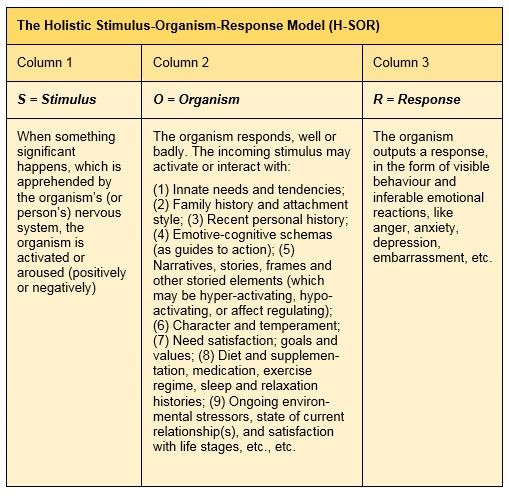
(We should have included “core affective feeling state” of the body-mind in Column 2 above.)
While the simple SOR model was created by an American psychologist, in the functionalist tradition – Robert Woodworth – in 1918 (or earlier – See Woodworth, 1929[9]); our model straddles most of the major schools of psychology and related subjects; including physiological psychology; nutritional science and nutritional psychiatry; sleep science; health coaching; scientific relaxation processes, like PMR; attachment theory; personality adaptations theory; affect regulation theory; sports psychology; developmental psychology; neuroscience; and many others.
 However, we do agree with Woodworth (1929) that the state of the organism – (or body-brain-mind of the socialized individual) – determines a person’s response to any particular stimulus.
But we then move way beyond Woodworth (1929) by clarifying the fact that there are a multitude of factors that affect the state of the organism, and not just ‘beliefs’, ‘thoughts’, or ‘lusting after mother’, or ‘schedules of reinforcement’. (And there is no point trying to psychoanalyze [or CBT-er-ize] a person who is chronically sleep-deprived, and lacking in (or overloaded with!) sufficient glucose to fuel reasonable mental functioning! [Taylor-Byrne and Byrne, 2017; and Taylor-Byrne, 2019, in the endnotes, below].)
~~~
You might want to read the second page about the Holistic SOR model.
~~~
 The Institute for Emotive-Cognitive Embodied Narrative Therapy (E-CENT)