From Rational Emotive Behaviour Therapy (REBT) to Emotive-Cognitive Embodied Narrative Therapy (E-CENT)

This content elaborates on the evolution of counselling and therapy theories from Rational Emotive Behaviour Therapy (REBT) to Emotive-Cognitive Embodied Narrative Therapy (E-CENT) over 17 years. The authors critically assess and reject the core principles of REBT and propose an alternative approach of addressing emotional disturbance by incorporating body-brain-mind factors. Their critique of REBT is highlighted, and it explains the flaws in its foundational theories. The authors present a structured and comprehensive refutation of various REBT positions and provide an extensive reflective summation of the entire book’s content, emphasizing the fundamental flaws in REBT and the evolution of their alternative therapeutic approach.
~~~
– Over a period of 17 years, we have published about 25 books which are directly or indirectly linked to the core theory of E-CENT counselling and psychotherapy; for examples, on the subjects of how to control anger, anxiety, depression; how to use writing therapy to create a better life for yourself; how to improve your sleep, diet, and exercise; how to overcome childhood developmental trauma; and much more besides. See our page of Books linked to E-CENT counselling.
~~~
Change is the law of life, according to Taoism; and change, upheavals and reformulations are at the centre of scientific enquiry, even in the world of counselling and psychotherapy, coaching and mentoring, and psycho-education. (See for example, Thomas Kuhn’s theory of Scientific Revolutions).
This website would not have come into existence if it had not been for the following facts:
- Jim Byrne and Renata Taylor-Byrne were impressed by Albert Ellis, and they became fans of him and his theory of Rational Emotive Behaviour Therapy (REBT). We foolishly thought that we were learning how to “think more effectively”, whereas in fact we were imbibing a set of dogmas about how all human disturbance could be captured in the simplistic ABC model, which asserts, after Epictetus (a slave who was the son of a slave!), that people are NOT disturbed by what happens to them, but rather by unrealistic, unreasonable, irrational beliefs.
- Over a period of years, from 1992 to 2007, we became more and more disillusioned by, at first, gaps in the theory; moral weaknesses in the theory; and finally, no substantial basis to the theory whatsoever!
- Albert Ellis died in July 2007, and soon afterwards we had the idea of perhaps finding the shards and chippings of REBT, which were left over after our original piecemeal critiques. And that was the original basis for setting up this institute. However, when we got down to it, we found that the entire theory of REBT was insupportable in the face of critical analysis.
- Please see our critique here: A Major Critique of REBT.
- And our newly evolved theory of human disturbance, and how to help disturbed individuals, with body-brain-mind-based counselling and therapy, can be found in this book:
Lifestyle Counselling and Coaching for the Whole Person.
Lifestyle Counselling and Coaching for the Whole Person (2): How to incorporate nutritional insights, physical exercise and sleep into talk therapy
 In this book, you will find a very clear, relatively brief, easy to read introduction to a novel approach to ‘counselling the whole person’. This emotive-cognitive approach does not restrict itself to mental processes. We go beyond what the client is ‘telling themselves’, or ‘signalling themselves’; or what went wrong in their family of origin.
We also include how well they manage their body-brain-mind in terms of diet, exercise, sleep, breathing, stress management, and emotional self-management (including self-talk, or inner dialogue). And we propose that it is better for counsellors and therapists to operate in a primarily right-brain modality, in most situations, and to use the left-brain, cognitive processes, secondarily. (The exception to this rule is when the counsellor is working on the client’s lifestyle factors!) More…
~~~
If you are interested in reviewing a brief summary of our critique of REBT, please see the postscript, helow.
~~~
That’s all for today.
Best wishes,
Jim Byrne, Doctor of Counselling
Executive Director. The Institute for Emotive-Cognitive Embodied Narrative Therapy (E-CENT)
21st March 2024. Updated on 8th June 2024
~~~

~~~
Summary of A Major Critique of REBT
By Dr Jim Byrne, Doctor of Counselling
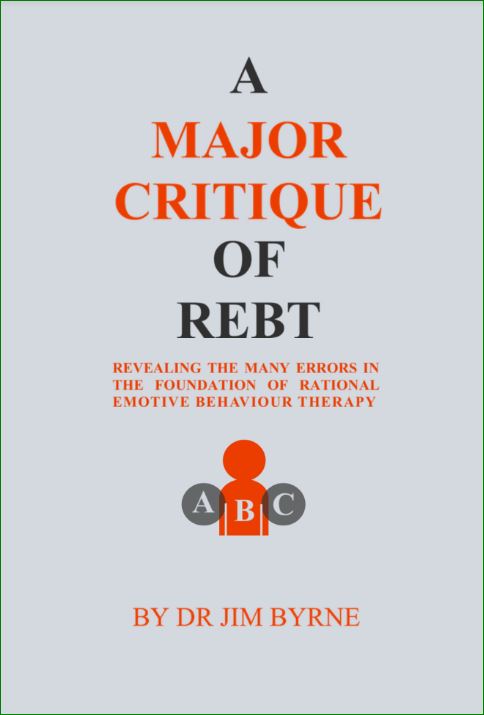 This book contains a summarized account of the author’s journey through Rational Emotive Behaviour Therapy (REBT) – from beginning to end. He began, in 1992, as a fanatical supporter of REBT, which is the original form of Cognitive Behavioural Therapy (CBT).
Then, while trying to rescue REBT from two critics (Bond and Dryden, 1996), in the period 2001-2003, he accidentally uncovered several flaws in the foundations of this theory of therapy.
Next, he wrote a series of papers, exploring some of the weaknesses of REBT – all the time hoping he would be able to salvage a defensible core of the therapy. But eventually, this led him to the development of a completely new theory of therapy, which rejects virtually all of the major theoretical and practical elements of REBT – apart from those moderate Stoical and moderate Buddhist influences that went into the origin of Dr Albert Ellis’s theory. (See Byrne 2013 and 2016a).
(Please see our critique here: A Major Critique of REBT.)
The intellectual journey described in this book took twenty-five years to complete.
The whole of Part 1 was written in 2017. This is a critique of the fundamental flaws in REBT (and in all forms of CBT which are based on the ABC model; and in much of extreme Stoicism and extreme Buddhism).
But most of Part 2 – which contains the historical documents – was written between 2009 and 2012, apart from the Introduction to Part 2 and the Reflections upon those historical documents, which were both written in 2017. And Chapter 7 which was written in 2003.
 Although this book is a critique of Rational Emotive Behaviour Therapy (sometimes called Rational Emotive & Cognitive Behavioural Therapy), some of the key criticisms apply just as much to all forms of Cognitive Behavioural Therapy (CBT) which utilize the ABC model (which includes Beck [1976] and Burns [1990]); and which subscribe to a famous (or infamous) statement from Epictetus to the effect that “…humans are not disturbed by what happens to them”. (Epictetus was a first century CE slave, of Greek origin, who grew up in slavery in Rome, and gained his freedom because of his learning of philosophy. [Irvine, 2009; and Epictetus, 1991]).
Chapter 1, below, establishes a fundamental flaw in the core concept of REBT, (which it shares with most systems of Cognitive Therapy and CBT therapies [including those of Beck, Burns, Maultsby, Meichenbaum, and others]): the idea that humans are disturbed, and disturbable, because of their thinking, and their thinking about their thinking. This theory was borrowed from Epictetus, an ancient Roman philosopher, and then re-created, or somewhat modified, by Dr Albert Ellis, on the basis of a bit of ‘pure reasoning’, (Ellis, 1962), which Dr Byrne has discovered was then – historically – invalidated by an extensive piece of empirical research by Dr Martin Seligman. (See: Peterson, Maier and Seligman, 1995).
This claim (that people are upset by their thinking) is clearly irrational – meaning “not logical or reasonable” (Soanes 2002), for three main reasons:
- Humans are mainly emotional or feeling beings from birth, and our thinking, in socialized language, is grafted on to our affective states.
- Humans are not often (and certainly not normally) disturbed in the absence of a real, noxious, activating event [or a recollection or anticipation of a real noxious activating event]. Take away the noxious event or stimulus, and the disturbance normally abates.
- The idea that humans are not disturbed by what happens to them comes from an ancient Roman philosopher (Epictetus), and is not supported by modern psychological studies. Modern psychological studies, in behaviourism, attachment theory, existential studies, social psychology, and many other sources, support the idea that people are shaped by their experiences; affected by their relationships; and that emotional disturbances are inherent in human existence.
Dr Byrne’s book could have ended at that point, but he goes on to examine Dr Ellis’s further attempt to support his theory with a case study – illustrating the use of his ABC model to help a disturbed therapy client. (The ABC model says: ‘A’ is an Activating event [normally a negative experience], which triggers a ‘B’ which is a Belief [normally an ‘irrational belief’]. The belief, then, ‘more directly causes’ the person’s outputted ‘C’ or Consequent emotional and behavioural response).
However, Dr Byrne has shown, by meticulous analysis of that case study, that it did not provide any significant support for Ellis’s theory – which was borrowed from Epictetus – which claims that the client was not upset by his negative experience, but rather by his ‘irrational beliefs’ about the experience.
(See Albert Ellis and the Unhappy Golfer for more.)
 Then, in Chapter 3, Dr Byrne compares Dr Ellis’s ABC model with the SOR model of neobehaviourism, (which says this: A Stimulus [S] impacts an Organism [O] producing an outputted Response [R]). As a result, he (Byrne) finds that it is essential to ‘add back the body’ to the ABC model; and once that is done, the core theory of REBT falls apart, because now we are dealing with a whole-body-brain-mind-environment-complexity, rather than a simple ‘belief machine’.
Furthermore, this complex-body-brain-mind engages in ‘warm-perfinking’ – (which means, perceiving-feeling-thinking) – which is coloured by emotion from beginning to end), rather than cool thinking and reasoning.
Again, this book could have ended there, and REBT would have been broadly invalidated as a theory of human disturbance. But Dr Byrne goes on to link the ABC model to the concept of ‘extreme Stoicism’, which is ‘a philosophy of wishful thinking about impossible goals’!
In Chapter 5, Dr Byrne reviews the research on innate emotional wiring; higher cognitive emotions (which are socially shaped); and culturally specific emotions. He looks at the fact that emotions evolved, to guide our actions, long before our ancestors could communicate with speech.
We know that those guiding emotions reside in the most primitive parts of the brain, and that they control the development of our thinking, in interaction with our earliest social environment (meaning mother, father, and significant others). And our thinking depends upon our feelings. Feelings, it seems, are both regulated and regulating. (Hill, 2015). Language is woven into our socialized experience, but only as one of many strands, the most fundamental one of which is innate feelings about everything we see, hear and apprehend.
In Chapter 6, Dr Byrne presents a succinct refutation of the various REBT positions, and a restatement of his own (emotive-cognitive embodied narrative therapy) E-CENT position on:
- The ABC model;
- The concept of ‘awfulizing’;
- The concept of ‘Demandingness’;
- The idea that ‘I can’t stand it’;
- The REBT process of ‘disputing’ irrational beliefs;
- And, the so-called ‘Effective new philosophy’.
At the end of this process of critical analysis, very little is left of the philosophy of REBT.
Then, in Part Two of this book, in Chapters 7 to 14, the author sums up his long journey from his early attempts to rescue REBT and its ABC model from their critics (Bond and Dryden, 1996), and shows how the whole theory fell apart in his hands, over a period a several years, as he wrote seven papers of critical reflection.
Finally, in Chapter 15, he produces an extensive, reflective summation of the entire book’s content.
~~~
Hebden Bridge, June 2017 and May 2019. Updated in June 2024
~~~
Copyright (c) Dr Jim Byrne
~~~
For more information about Dr Jim Byrne, please go here: About Dr Jim Byrne.***
~~~
For more information about books written and/or co-authored by Jim Byrne, please go here: Self-help books based on E-CENT theory.***
~~~
 The Institute for Emotive-Cognitive Embodied Narrative Therapy (E-CENT)